Butterfly Valves
Actuator options:
- With handwheel or hand lever
- With an electric actuator
- With hydraulic actuator
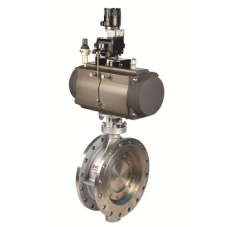
- With a pneumatic actuator
Liner material options:
Refloworx offers centric butterfly valves for all types of fluids including corrosive fluids and high-purity applications: EPDM, NBR, PTFE, PTFE conductive, Ultraflon®, Ultraflon® conductive, UltraleneTM.
Butterfly Valves
Butterfly valves are commonly used in various industries to stop the flow of fluid or gas during a process. These valves rotate around an axis, resembling a butterfly’s wings, and are known as quarter-turn valves. Its closing mechanism is via a disk that rotates at about 90° from fully opened to fully closedthe shape and design of the disk influence the capacity and flow characteristic of the valve.
This type of valve is popular due to its lightweight, compact design, quick shutoff, satisfactory performance, and low cost – compared to many other valve types. The high-performance ones offers tight shutoff and outstanding sealing qualities.
They are mainly used for isolation services; however, specific designs are suitable for regulating services.
Various materials can be used for the body, disk, and seat to make it suitable for almost any liquid. Although they were initially used in the water industry, with more chemical-resistant elastomers becoming available, their use spread to a wide range of applications in process industries.
As one of Singapore’s leading butterfly valve suppliers, Refloworx offers a variety of high-performance butterfly valves in sizes from DN40 to DN3000, with multiple corrosion protection options, including epoxy coating, halar coating, and others.
Ours are designed for various applications, including isolation and modulating services for water, effluent water, seawater, chemicals, oil, and gas.
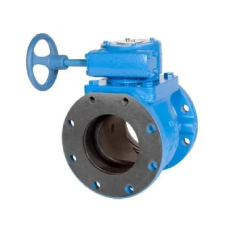
Flanged Butterfly Valves
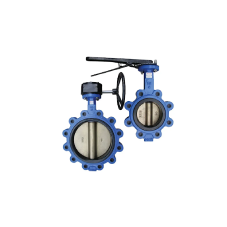
Lug Type Butterfly Valves
Triple Offset Butterfly Valves
Plug Valves
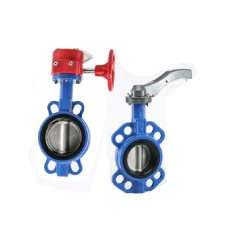
Wafer Butterfly Valves
FAQ's
A butterfly valve is a quarter-turn (rotary) valve with a disc rotating around an axis, like a butterfly’s extended wings. Its closing mechanism is via a disk that rotates at about 90° from fully opened to fully closed. It can also be equipped with a position indicator.
Shape and design of the disk influence the capacity and flow characteristic of the valve.
Compared to other valve designs like gate valves, the advantages of butterfly valves include being suitable for throttling or regulating flow and fully open and closed positions. The low torque requirement, wide controllable range, and tight shutoff features make for effective and sustainable process control.
Carbon steel, stainless steel, and aluminium bronze are materials commonly used in the construction of bodies.
For example, lug-style butterfly valves used in dead-end service typically possess a lower pressure rating.
The basic operation of a butterfly valve is simple. A handle or actuator rotates the disc inside the valve body – changing the position of the disc, either opening or closing the valve.
When the valve is fully open, the disc’s position is parallel to the direction of fluid flow, allowing the fluid to flow through the valve with minimal restriction. When the valve is fully closed, the disc’s position is perpendicular to the direction of fluid flow, blocking the flow completely.
When it comes to process control, butterfly valves offer many advantages. First, they are highly reliable and efficient, providing excellent flow control even in the most challenging conditions.
The correct choice of liner material for the application is essential for successful operation and long service life.
Some typical applications of butterfly valves include water treatment, sewage management, HVAC, shipbuilding, gas, oil and gas processing, power plants, and more. They are also used in solar thermal power stations, steelworks, pulp and paper, refineries, and petrochemicals.
Resilient seated butterfly valves are divided into two main categories, double-flanged type and sandwich type.
They can also be categorised based on the disc design, such as
- Concentric butterfly valves
- Eccentric butterfly valves (single and double-eccentric)
- Triple offset butterfly valves (Triple-eccentric)
- Wafer butterfly valves
- Lug-style butterfly valves
- Semi-lug butterfly valves
- Zero-offset butterfly valves
- Flanged butterfly valves